
EPEC Team’s Senior Data Analyst Rick Naigle is monitoring early mail-in ballot processing throughout Virginia’s 45-day early voting stretch and documenting a “statistically extreme” number of rejected mail-in ballots in some localities.
His analysis covers early voting data for Oct. 23, 2026 from the Daily Absentee List (DAL) extract provided by Virginia’s Department of Elections. For a baseline, he calculates the statewide average for mail-in ballots that are rejected at about 1.3% per 100 ballots.
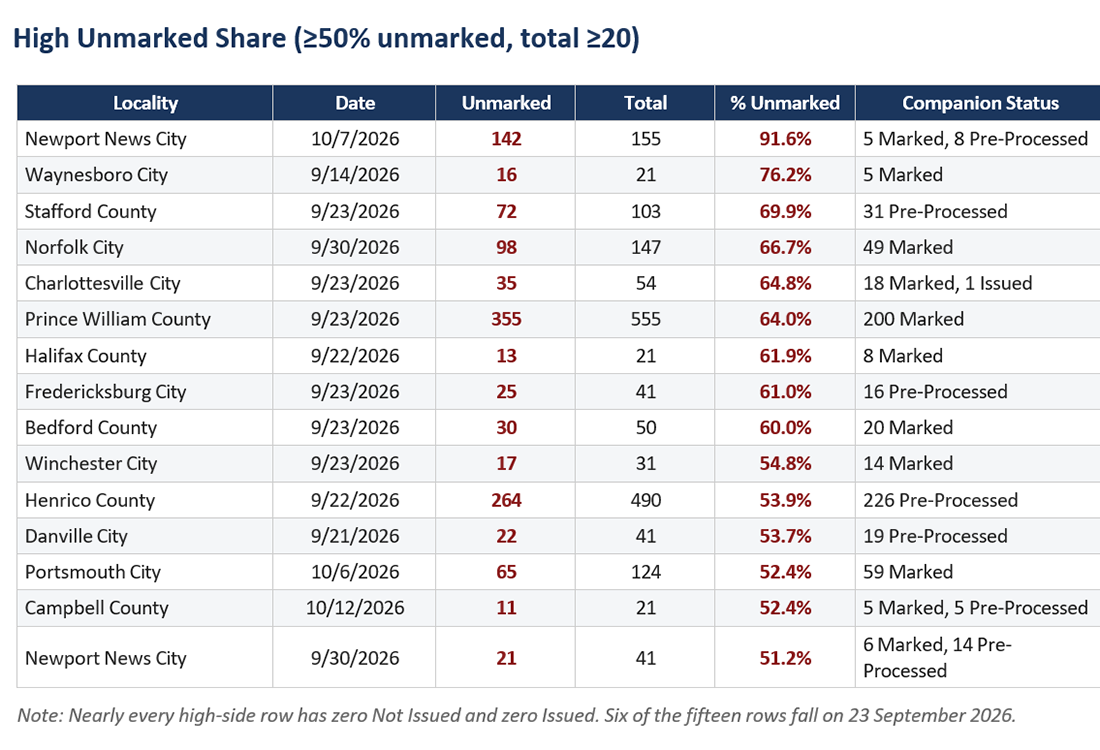
After reviewing about 30 days of early voting ballot-handling data across all of Virginia’s 133 localities, the datasets show 15 localities with abnormally high numbers of rejections. These are mail-in ballots that are received back, but set to “unmarked” status in the DAL report. Other localities show zero rejections. Both rates are statistically extreme.
For example, some localities show rejection rates as high as 50% of mail-in ballots processed on some dates throughout the early-voting period, with others as high as 97%.
At the other end of the spectrum, the analysis also shows localities with zero ballots set to “unmarked,” which is also way below the statewide average.
These patterns and wild swings in ballot statuses across absentee-ballot processing offices are statistically extreme relative to the statewide distribution. They warrant a review of public-records requests under Virginia Code §§ 24.2-709 and 24.2-709.1.
A mail-in ballot set to “unmarked” status may be lacking material information, be defective, ineligible (voter already cast a ballot), or even undeliverable. That status may change back if the voter takes action on material omissions. Or it could remain rejected, perhaps because the voter is ineligible and was issued a mail-in ballot in error.
The analysis reviewed Virginia’s Daily Absentee List (DAL) extract of early voting data for Oct. 23, 2026, which covers 261,310 ballot status reports across 3,016 locality-date rows (about 30 days of data from 133 localities). See or download the full report below.