
Bottom Line Up Front: Unobserved Mail-in Ballots Lack Chain of Custody
EPEC Team’s Director Rick Naigle is working through the data from the midterm elections, and following updates from the Department of Elections’ statistics page here:
https://enr.elections.virginia.gov/results/public/virginia/elections/2026-November-General/stats
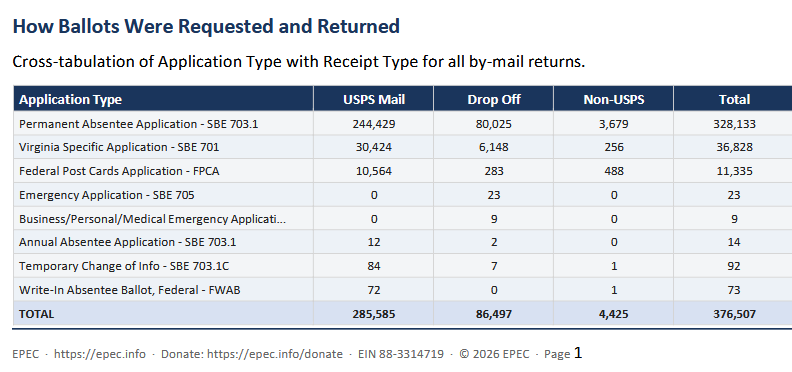
Of the 3.7 million ballots cast (about 56.5% turnout) in the midterm elections, about 376,511 were cast as mail-in ballots, or about 10% of the total vote tally.
Of those mail-in ballots, about 75.8%, or 285,589 ballots, were returned via the United States Postal Service.
The rest? The method cited for 86,497 of the mail-ins is “drop off.” These were delivered back for processing without any of the special mail handling procedures that the Postal Service applies to election mail to prevent tampering.
According to the data, another 4,425 (1.2%) were logged as delivered by a non-USPS carrier. That means that about a quarter of all mail-in ballots were without any chain-of-custody documentation prior to drop-off.
UOCAVA (military and overseas) activity came in at 17,219 records, almost entirely via Federal Post Card Application. Many of those ballots were issued to non-overseas addresses.
Because these returns occur outside the polling-place chain of custody, the volume and method of return have direct implications for public confidence in the integrity of the final count.
Summary: Permanent Absentee applications account for the large majority of by-mail returns. Drop Off is used most frequently with Permanent Absentee ballots. Non-USPS returns remain a small statewide share but are concentrated in a handful of localities
By-mail ballots travel outside the controlled environment of the polling place. Drop-Off and Non-USPS returns never enter the U.S. Postal Service on the return path. While Virginia law requires chain-of-custody procedures for drop boxes, the volume of returns that bypass the postal system, combined with the absence of individual request and receipt timestamps in this extract, limits independent verification of the end-to-end process.
Public confidence depends on transparent, observable controls. Large differences in return methods across localities raise legitimate questions about consistency of administration. Localities with extreme Non-USPS or Drop-Off rates merit closer operational review so that voters and observers can see that the same standards apply everywhere.
Full Analysis by Rick Naigle is here:
One Quarter of ‘Unobserved’ Mail-in Ballots Lack Chain of Custody