



From EPEC Team Newsletter:
(This month, EPEC Team analysts are spotlighting the impact of new election laws in Virginia, and their influence on incomplete and inaccurate voter rolls.)
Why are so many voter registration records in Virginia in violation of the Commonwealth’s statute governing them?
EPEC Team’s Senior Data Analyst Rick Naigle has found, on Virginia’s official Registered Voter List (RVL), close to a half-million voter registrations with no middle name, missing genders, even missing first and last names as required.
The answer can be traced to administrative law from agencies that effectively dilute the original statute’s intent, using lax standards built around the vague use of “reasonable” in voter-list maintenance requirements.
Congress helped create these conditions. By not defining what “reasonable” actually means in Section 8 of the National Voter Registration Act (NVRA) (“Motor Voter”), vague and inconsistent standards wend their way into statewide interpretations.
Take Virginia statute 24.2-418, which governs registration applications. The law is clear about the requirements.
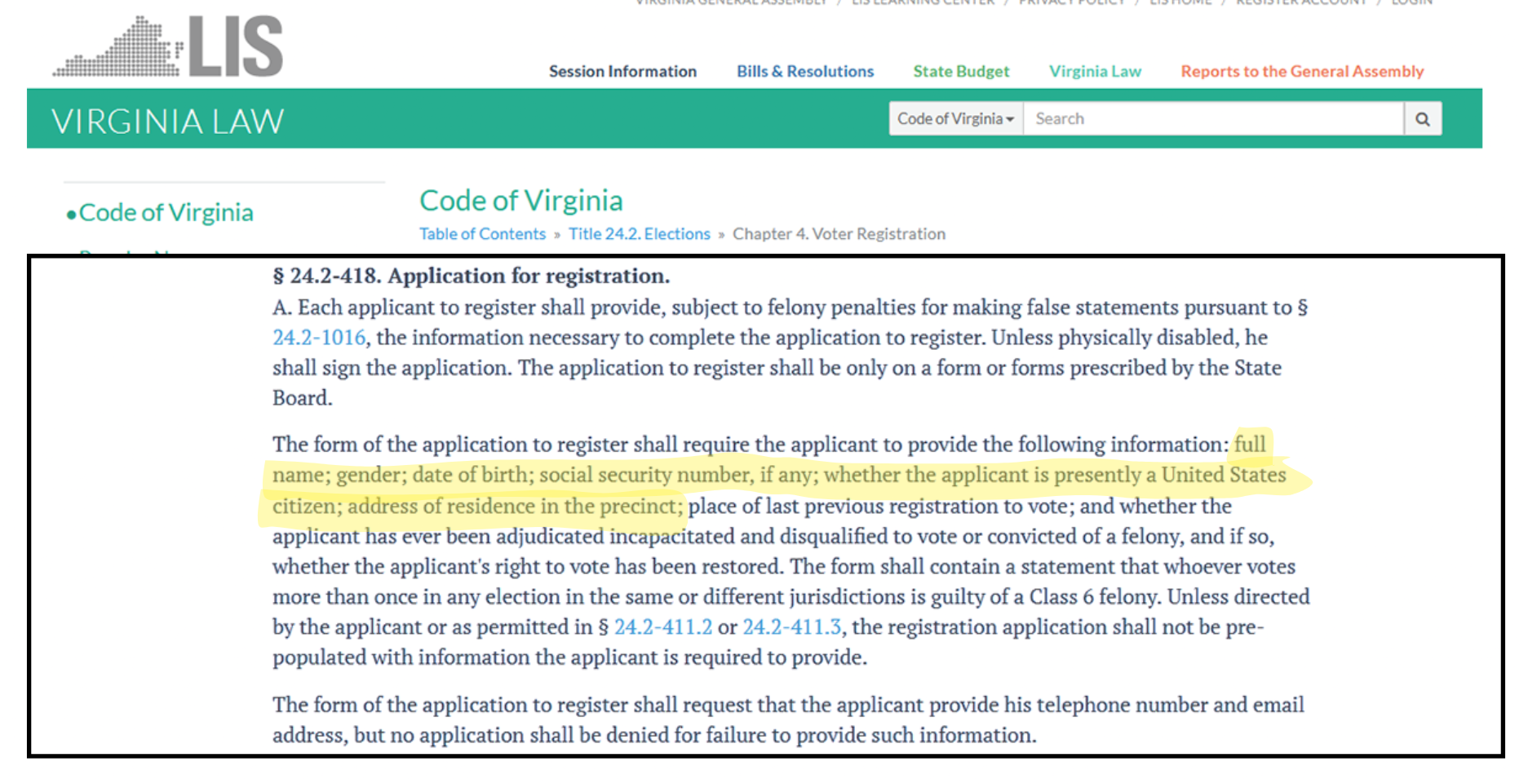
The statute says:
The form of the application to register shall require the applicant to provide the following information: full name; gender; date of birth; social security number, if any; whether the applicant is presently a United States citizen; address of residence in the precinct; place of last previous registration to vote; and whether the applicant has ever been adjudicated incapacitated and disqualified to vote or convicted of a felony, and if so, whether the applicant’s right to vote has been restored.
Then comes VA administrative code, a kind of unaccountable law-making by executive branch agencies, which “interpret” the intent of laws passed by the elected assembly, often with strategic uses of “may” (optional) and “shall” (required).
For example, Virginia’s administrative code covering the voter registration statute, “1VAC20-40-70”, says the registrant’s middle name “may be material” to determining eligibility to vote.
It continues: If the applicant does not include a middle name and does not check the box indicating none, the administrative code says the registrar “shall” make an effort to find out if the registrant has a middle name. However, if they are not successful in this effort, it’s effectively a shrug. The general registrar “shall” register anyway.
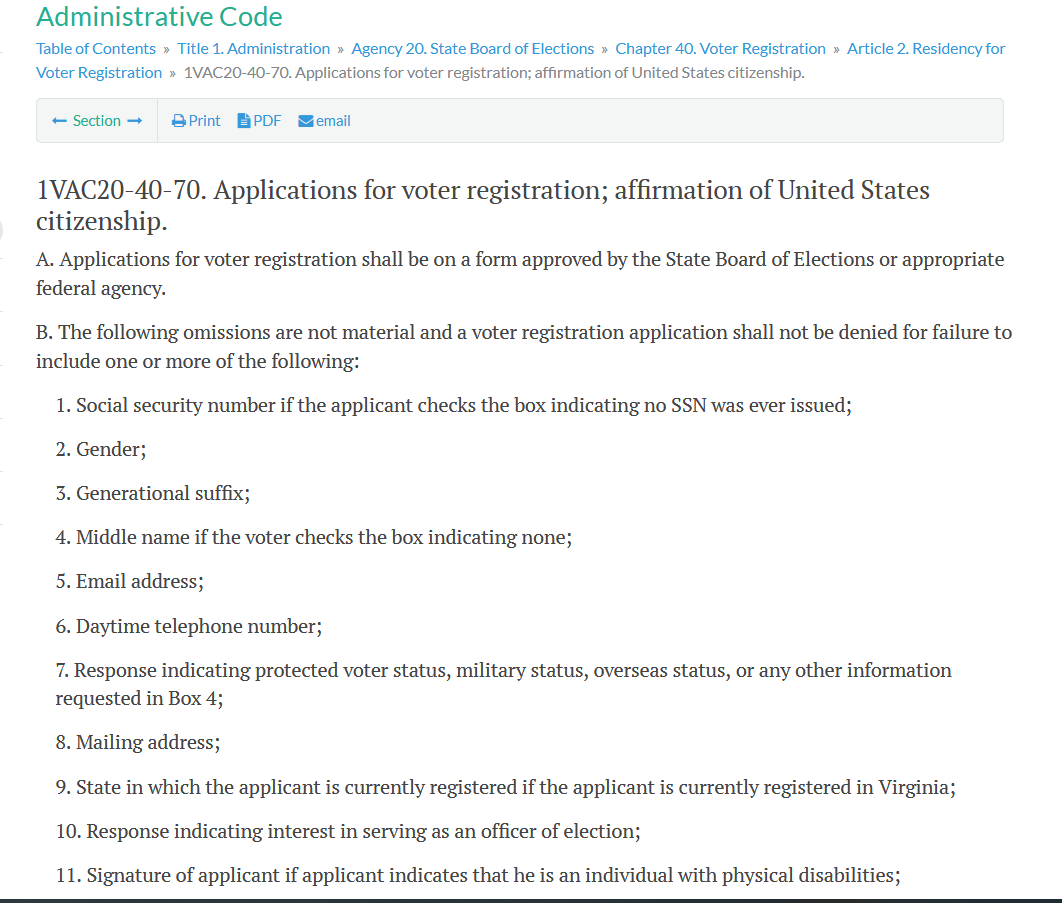
The net result: 487,000 registrations on Virginia’s voter rolls with no middle name on file — despite a law requiring “full legal names” on voter registrations. The administrative code creates wildly inconsistent records of a key identity marker: the middle name. It is ripe for challenge.
Naigle also sees over 31,000 voter registration records where the required gender is listed as either “U” or “X” as well as “M” or “F.” The statute says gender is material to a completed application to register. The administrative code says it is not.
In the era of big data and growth of machine learning algorithms in software systems, administrative codes such as these are moving in the wrong direction. They effectively create lax standards on record-keeping, and opportunities for manipulation, such as duplication of registrations using slight name variations — all while ignoring modern day tools that can easily update records.
No one appears to be doing anything about the potential for manipulation.
The Senate has not allowed further debate on the SAVE America Act, an overdue update of the decades-old NVRA that brings voter-roll maintenance into the 21st century, in addition to requiring proof of citizenship to register and photo ID to vote.
According to Naigle, over 500,000 registrations overall are showing defects in material information on registrations, which is about 8.5% (1 in 13) of Virginia’s ~6.4 million registered voters.
From a data quality standpoint, this represents a scale of error that can become a vector for intentional manipulation of voter registrations by determined harvesters.
Enter a new election law in Virginia as of July 1st, (HB 640), that will curtail citizens’ rights to challenge whether registrars are doing enough to update incomplete rolls.
The new law eliminates the process by which any voter could challenge, in a polling place on the day of an election, the right of any other voter to cast a ballot.
The bill also eliminates the process by which any three voters could challenge a voter’s registration before the general registrar; such challenges may still be made by filing a petition with the circuit court of the county or city where the voter is registered.
The law gives GRs a pass from even listening to their localities’ citizens about whether voter lists are accurate and contain required, material information.
HB 640 is among a flurry of new laws that EPEC Team is spotlighting this month.
Many of them are among troubling trends in trusted elections: crazy-quilt NVRA interpretations of “reasonable” maintenance efforts, all while allowing required fields under the NVRA, such as month and date of birth of the registrant, to be hidden from citizen oversight of voter rolls.
A filing by the Dept. of Justice, which asked the Supreme Court to review an NVRA case involving Arizona, is yet another example of why it needs review.
Thanks to unclear rulings about the NVRA’s 90-day rule that prohibits “systemic” purges from voter rolls three months before an election, many states use that rule to allow noncitizens — ineligible to register in the first place — to remain on voter rolls.
“The DOJ made its argument on May 26 in a brief urging the high court to grant the petition in the case of Republican National Committee (RNC) v. Mi Familia Vota,” Zero Hedge noted of Arizona, where two laws now govern the state’s elections.
The DOJ argues in its brief that the NVRA’s restrictions on taking individuals’ names off the list of eligible voters in the 90 days preceding an election “do not apply to noncitizens who were never eligible to register in the first place.”
The motion for review refers to a prior ruling by the Ninth Circuit as “badly mistaken,” which deepens a split among federal courts of appeals, and “risks significant harm,” said Hashim Mooppan, filing as acting solicitor general.
Using the reasoning of the Ninth Circuit, “a State could never remove a noncitizen from its voter rolls once registered,” he said. “That cannot be correct and cries out for reversal,” Mooppan said, urging the Supreme Court to grant the RNC’s petition.
EPEC Team is delving into these issues all this month, guided by an Election Bill Tracker list compiled by election experts Andi Bayer and Susan Hogge.
Working with citizen groups, they spent months following Virginia General Assembly debate and passage of the bills. They compiled the information into an easy-to-understand spreadsheet that is available to download — and will be updating the information on regular intervals as a service to the Commonwealth.
Download the Spreadsheet Here
In addition to the hundreds of thousands of voter registrations that are incomplete and out of compliance with the intent of registration statutes in Virginia, EPEC Team believes that HB 640 — as well as existing administrative codes on voter-registration statutes — are ripe for legal challenge.
EPEC Team and its partners are committed to raising the public’s knowledge of the these laws. We urge readers to download the tracker and understand their impact.