



The special election on gerrymandered House districts is off, says Tazewell judge in a new ruling that also takes aim at the use of ‘fairness’ in the referendum question itself. Appeal is in, too.
From the EPEC Team newsletter:
Virginia’s elections chief and the Democrat Spanberger administration have appealed already, but for now, the April 21 special referendum to “temporarily” redraw congressional maps is halted.
Full stop on the special election statewide (including early voting), according to the Feb. 19 temporary restraining order from Tazewell County Judge Jack Henry, who wrote: (emphasis ours):
“The court finds that Plaintiffs have an extraordinarily high likelihood of success on the Merits. Moreover, the Court finds that Plaintiffs are also likely to succeed on the merit of their claim that the referendum on the proposed amendment violates the timing requirement of Article XII, Section 1 because early voting is set for “sooner than 90 days after’ the January passage of House Joint Resolution 4.”
The plaintiffs in the latest lawsuit against Virginia Democrats are the Republican National Committee, the National Republican Congressional Committee, Rep. Ben Cline (R-6), and Rep. Morgan Griffith (R-9).
See the latest Tazewell order here:
See the appeal of the order (Koski v. RNC) here:
The betting among pundits is that Virginia’s Supreme Court will punt again, and issue another ruling that takes up an appeal of whether the vote itself was illegally constituted — only after the electorate votes.
The latest ruling from Tazewell County takes aim at that argument as well.
To allow the vote before the Constitutional questions and legal issues of how the vote to amend the Constitution were constructed “threatens to cause an irreparable injury,” the judge wrote in the Feb. 19 ruling.
The arguments are also different in this lawsuit than the previous action that Virginia lawmakers brought.
It’s a fast-moving case, so we’ll keep this update brief
The case also brought the wording of the referendum question to the fore. The special election (now halted) would ask the voters:
“Question: Should the Constitution of Virginia be amended to allow the General Assembly to temporarily adopt new congressional districts to restore fairness in the upcoming elections, while ensuring Virginia’s standard redistricting process resumes for all future redistricting after the 2030 census?”
Judge Henry noted that the plaintiffs would likely succeed on their claim that the ballot language itself is misleading, “in particular the ‘restore fairness’ language because it would lead a voter to believe he or she were doing something unfair by voting against the proposed amendment.”
ballot language itself is misleading, “in particular the ‘restore fairness’ language because it would lead a voter to believe he or she were doing something unfair by voting against the proposed amendment.”
Steven Koski, the recently appointed Commissioner of Elections in the Spanberger administration, leads off the appeal with three big arguments. It says the court erred on the likelihood of succeeding on the merits; the circuit court is wrong about the “irreparable harm” argument; and the court did not balance out the public interest.

Meanwhile, Back in the Assembly
The Democrat-majority assembly released new maps of the gerrymandered districts on Feb. 17 as part of its budget bill. This one is an update from the Feb. 4th maps it released. The new maps can be downloaded here:
https://lis.virginia.gov/bill-details/20261/HB29 (“supporting documents”).
EPEC Team worked up a version of the latest map boundaries, and zoomed in on where the latest maps remove voters from District 2, currently held by Republican Jen Kiggans, and moves them into District 3, currently held by Democrat Bobby Scott.
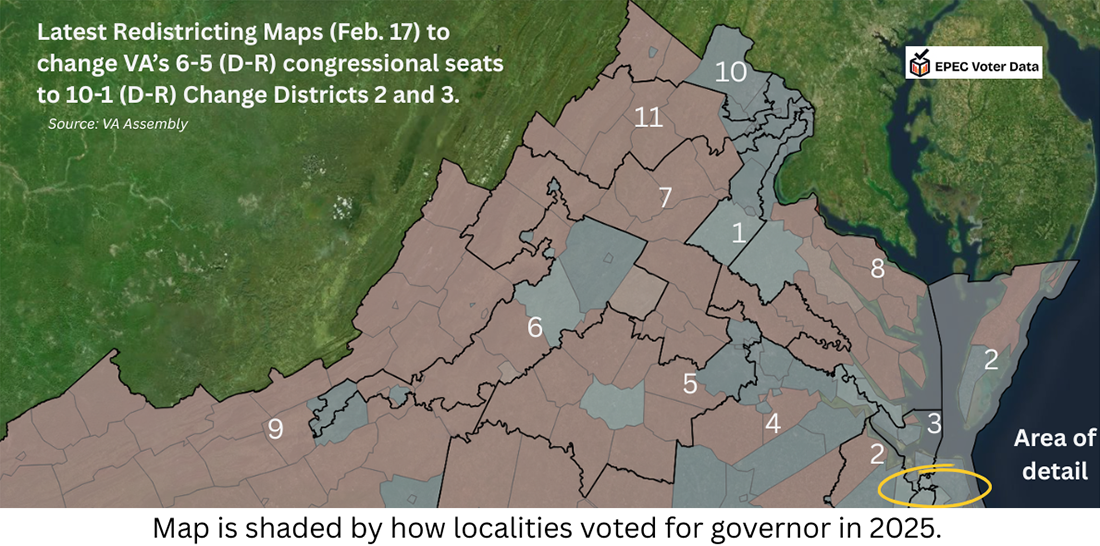
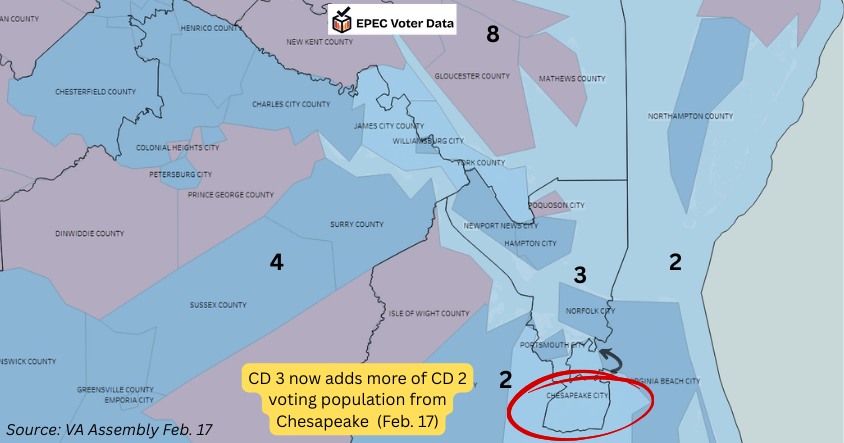
More in our next report about the legal fights over the maps. #