Republished from DigitalPollWatchers.org, by Jon Lareau, Executive Director, EPEC Team
- We have updated our previous analysis of noncitizens on Virginia’s voter rolls with a voting history.
- The Commonwealth’s new policy is that declared noncitizens are not to be removed from voter rolls for 90 days prior to primary and midterm elections.
Abstract:
Using data provided by the VA Department of Elections (“ELECT”), we have identified at least 8,566 unique registrations that were self-identified as “Declared NonCitizen” and removed from the voter rolls since May of 2023.
Of those 8,566 removals of self-declared noncitizens — which Virginia’s constitution prohibits from registering and voting, we see 1,756 registrations with a corresponding record of ballots cast, according to the statewide Voter History List (VHL) record.
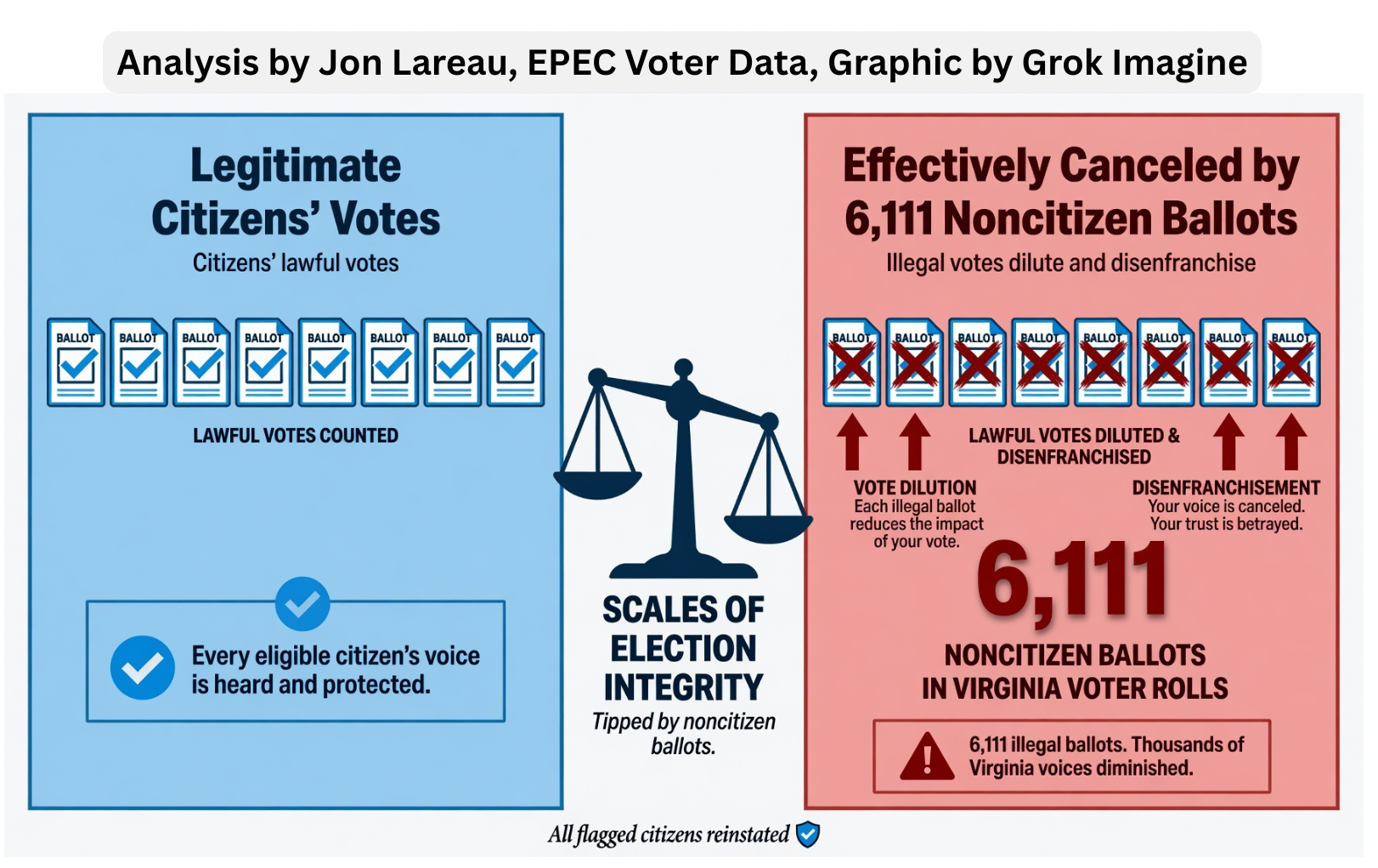
As of February of 2019, that brings the number of ballots cast by declared noncitizens to 6,111, according to official records. Those are the records we know about.
In addition, the Daily Absentee List (DAL) data of Virginia’s 45-day early voting period shows an additional ten (10) noncitizen registrations and ballots — none of which are found in the Voter History List (VHL), the final tally of who voted.
Therefore, we see 6,121 illegal ballots cast by self-identified noncitizens, from 1,766 registrants who were removed from the voting rolls after self-declaring themselves as ineligible noncitizens. That’s according to the official Voter History List (VHL) and early voting data found in the Daily Absentee List (DAL) reports.
Voting as an ineligible individual is a Class 6 felony voting violation in Virginia.
Background on Non-Removal Policy:
After our initial post on this topic in March 2024, we submitted all of the relevant information for investigation to then-Attorney General, Jayson Miyares (R).
We did not hear back, nor did we receive any response or update on the matter. We are not aware of any action by the AG’s office on these apparent violations since 2024.
At the time in 2024, the Arlington County Electoral Board undertook its own investigation and voted 3-0 to send the information to the AG’s office as well. Fairfax County’s Electoral Board also issued a new policy on referring noncitizens with voting records to the Commonwealth Attorney. The policy stated:
“The General Registrar shall refer all individuals who were removed from the voter rolls pursuant to Va. Code § 24.2-427(C), after being identified by ELECT as noncitizens, to the Commonwealth’s Attorney and the Attorney General to determine if they have violated Virginia elections law.”
In October 2024, during early voting for the presidential election, the League of Women Voters along with the Biden Department of Justice sued VA, asking for an injunction to place approximately 1,600 removed noncitizen registrations back on the voter rolls. After two lower courts granted the injunction, the U.S. Supreme Court stayed the case, and the noncitizen removals proceeded as the litigation played out.
It is EPEC’s opinion that the Commonwealth of VA was correctly applying the National Voter Registration Act (NVRA) in this matter under the Youngkin administration and AG Miyares, as I detailed in an X.com post on Oct 12.
In 2025, the incoming Trump DOJ dropped the Biden DOJ’s lawsuit against VA; the League of Women Voters continued the litigation.
In April of 2026, Virginia’s Democrat Attorney General Jay Jones issued an advisory opinion to the Department of Elections that effectively adopts the same position of the challengers in the Biden DOJ / LWV lawsuit.
ELECT followed this advisory opinion with guidance to registrars instructing them not to remove any noncitizen voters within the NVRA’s 90-day “quiet period” around any federal election, including primaries.
As of May 6th 2026, ELECT is no longer populating noncitizen data into “hoppers” that are used to notify Commonwealth registrars of tasks that require their action.
Instead, ELECT has instructed registrars to change the categorization of existing flagged items in the hopper from “notify voter” to “needs research.”
Fairfax County’s Board of Elections has also apparently moved off its referral policy regarding noncitizens with voting records (as reported in its February 2026 Electoral Board meeting).
See Jones’ April 16, 2026 letter to VA Commissioner of Elections Steven Koski here.
See ELECT’s April 30, 2026 guidance document here.

We believe this interpretation is impacting the number of self-identified noncitizens that are removed and reflected in the Monthly Update Service (MUS). We have already seen an order of magnitude difference in the data since June 1, 2026, which covers the May time-period in the new policy.
Voter-List Maintenance Obligations:
As part of its responsibilities under law, the VA Department of Elections is required to identify and remove invalid or out-of-date registration records from the voter rolls.
One situation for removal is when a registrant has been determined (via self identification) to be a noncitizen. The VA Constitution prohibits noncitizens from voting in VA elections.
“In elections by the people, the qualifications of voters shall be as follows: Each voter shall be a citizen of the United States, shall be eighteen years of age, shall fulfill the residence requirements set forth in this section, and shall be registered to vote pursuant to this article. …” VA Constitution, Article II, Section 1. https://law.lis.virginia.gov/constitution/article2/section1/
Additionally, according to VA Code Section 24.2-1004, the act of knowingly casting a ballot by someone who is not eligible to vote is a Class 6 felony.
EPEC’s Analysis Methodology:
ELECT makes available for purchase by qualifying parties various data sets, including the registered voter list (RVL) and the Voter History List (VHL).
Additionally, ELECT provides a Monthly Update Service (MUS) subscription that contains (almost) all of the Voter List changes and transactions for the previous period.
The MUS datasets carry an “NVRAReasonCode” field that is associated with each transaction that gives the reason for the update or change in the voter record. This is in accordance with disclosure and transparency requirements in the National Voter Registration Act (NVRA).
One of the reason codes for records that are removed is “Declared Non-Citizen.”
EPEC has been purchasing and archiving these official records as part of our nonprofit mission to document and educate the public about elections processes, and drive voter participation.
(If you are interested in supporting this work, please head on over to our donation page, or to our give-send-go campaign to make a tax-deductible donation.)
EPEC looked at the number of records associated with unique voter identification numbers identified for removal from the voter record due to non-citizenship status, per entries in the monthly updates (MUS).
We correlated those results with our accumulated Voter History List (VHL) information to determine whether noncitizen registrations had corresponding records of ballots cast in previous elections.
We only considered those records that are currently in a non-active state as of the latest MUS transaction log. Some determinations of non-citizenship status in the historical MUS transaction log might have been due to error and subsequently corrected and reinstated to active status.
Important to note: We are not considering those records that had a “Declared Non-Citizen” disqualification, but were subsequently reinstated and reactivated by ELECT.
Other Gaps to Note:
While EPEC has periodically purchased full copies of the Voter History List for our archives, there is a known issue with the way ELECT handles removals from the voter record that can cause sampling issues — depending on the time the VHL file is purchased. The result: Records of some legitimately cast ballots can be missing from the VHL due to this policy.
Namely, when ELECT removes an ineligible voter from the voter list, it also removes all instances of that registration’s voter ID from its voter history information and other data files that it provides to qualified organizations. (In my opinion, that process eliminates important voting information and thus is not a good way to manage the data, but that is the way it is done).
In light of that, EPEC also used its archived versions of the Daily Absentee List (DAL) early voting files to check records of ballots cast that might otherwise be eliminated from the VHL.
Results:
We observe 8,566 unique voter records marked for removal with the reason of “Declared Non-Citizen” and not subsequently reinstated in the accumulated MUS record since EPEC began collecting the data in mid-2023, which covers 2019.
Of those 8,566 removals, there were 1,756 that also had corresponding records of recent ballots cast at some point in the official Voter History record that we could observe. There were 6,111 associated ballots cast since Feb of 2019. Figure 1 below shows the distribution of noncitizen voters in the cumulative MUS file history.
The blue trace represent the total identified and CANCELED noncitizen registrations, and the yellow trace represents the number of those records that also had corresponding records (at least 1) in the accumulated voter history data.

Note that the data contained in the monthly (MUS) updates often covers more than a single month’s period. In other words, the monthly MUS files are over-sampled.
Subsequent MUS reports can contain repeated entries from previous months, as their data may overlap. Our analysis used the first unique entry for a given voter ID marked as “Declared Non-Citizen” in the cumulative MUS record, that had not been subsequently reinstated, in order to build Figure 1 (above).
This data oversampling in the MUS may help explain the relative spike in the first (May 2023) bin compared to subsequent months in the chart above.
As VHL information can be incomplete depending on the time the VHL data was purchased in relation to the time that registrants were removed from voter records, EPEC also checked these noncitizen removals against the archived history of Daily Absentee List (DAL) early voting files that EPEC has accumulated.
There were an additional ten (10) noncitizen registrations and ballots as per the Daily Absentee List (DAL) data that were not contained in the Voter History data.
The total number of identified noncitizen ballots cast is therefore 6,121 by 1,766 registrants when combining unique VHL and DAL identifications.
These identifications represent only the individuals who declared themselves as noncitizens through official interactions with ELECT, DMV, or other agencies.
Each registrant is contacted by the registrar to confirm their noncitizen status prior to removal, as is the current policy. (Again … we are only considering those records that we’re flagged as “Declared Non-Citizen”, removed and never reinstated.)
The distribution of identified unique voter ID’s for the 1,756 identified noncitizen voters per VA locality is given below.
It should be noted that each ballot record has a specific locality associated with it stating where the ballot was cast, whereas unique individuals might move between localities over time.
The assignment of unique identified individuals to each locality is therefore based on the locality listed in the specific MUS “Declared Non-Citizen” record for that individual, while the assignment of ballot cast to Localities is based on the individual VHL/DAL records.
For example, an individual could have lived and voted multiple times in one locality, then moved to another locality and voted again — before being determined as a noncitizen. The same person would have generated multiple VHL/DAL records for each ballot cast, associated with potentially different localities.
(See a PDF of All Localities here, sorted by most removals.)

Discussion
Of particular concern is that we can see a significant order of magnitude (10 x) drop in the number of reported noncitizen removals in the MUS data covering May 2026.
This coincides with the recent aforementioned opinion letter from AG Jones (D) to the Department of Elections that advised ELECT NOT to remove self-identified noncitizens from the rolls.
The previous AG (Miyares) made the case that all of these removals were initiated by individual actions of self-identification via interactions with DMV or the Courts, which means they were “individualized” removals in accordance with NVRA.
AG Jones has now taken the opposite stance of Miyares, and is now effectively granting the relief that the DOJ & LWV were requesting in their suit by allowing self-declared noncitizens to remain on the rolls for 90 days prior to federal elections.
This explains the order of magnitude decrease in the number of noncitizen removals that we observe in the MUS data.
Another point of concern: Even though we see a decrease in the removal rate per the policy changes above, we see a significant increase in the number of ballots associated with noncitizen records compared to our previous documented trends.
The table below summarizes all of our previous posts on the subject. The cumulative number of identified noncitizen removals has increased by 1,233 since our last report, the number of associated ballots cast has increased overall by 2,596 (nearly double).
This equates to an average number of identified associated ballots cast per removed noncitizen of 0.713, while all other previous analyses had averages between 0.35 and 0.566.

Below is another streamlined view of the data. See full PDF here.

It is important to note that the records identified in the MUS are only those resulting from individuals who were removed after self-identifying as a noncitizen via interactions with DMV, ELECT, or other official avenues.
The data presented here specifically excludes those individuals that were subsequently reinstated onto the voter rolls.
The fact that a small number of identified noncitizen registrations are also associated with illegally cast ballots raises questions that citizens should be asking — and discussing with their legislators and government officials.
Each act of noncitizen voting is a de-facto disenfranchisement of legal voters’ rights, and is a punishable offense under VA law.
Additionally, this evidence which is derived from only official state records, directly contradicts multiple news media reports and attestations that noncitizen voting is a “Myth,” and that noncitizen voting happens “almost never.”
If the datasets from ELECT are accurate, at least 6,111 ballots have been cast by noncitizen voters just since 2019, as reflected in voting history records from 2023.
It is a legitimate concern; these discoveries are only the registrations found and removed from the voter roles by ELECT and that we can observe in the data.
It should also be reiterated that these are only the records that we can observe given our data repository, and how often we can realistically purchase and acquire voter history and voter registration information.
When a registration is canceled as ineligible, the individual’s voter history is also deleted. It is therefore likely that this analysis represents a significant undercount of the occurrences of noncitizen voters.
Additionally, we know that the MUS data does not entirely encompass all transactions performed on the RVL, so there may be other, unknown transactions we are missing.
We do not know how many exist if we don’t know about them.
With recent changes in guidance from the new AG Jones to ELECT, we expect our ability to observe and report on these issues will be significantly impacted.
Because ELECT will stop removals of many of these records, they will not show up in the MUS records, even though they have been correctly flagged via self-identification as ineligible to register or vote.
In effect, individuals who attest they are noncitizens and ineligible to vote will remain on Virginia’s voter lists prior to its primary and midterm elections.
(See prior analysis of noncitizen removals and voting history here: March 2024, July 2024, Sept 2024, Oct 2024, Nov 2024, Dec 2024, March 2025, August 2025, and Jan 2026 posts.)
Jon Lareau volunteers as Executive Director and Chief Technology Officer of EPEC, which he helped found in 2022. This post is republished from his DigitalPollWatchers.org blog.
Follow him on X