



A special election on a constitutional amendment question about whether to allow gerrymandered congressional seats across Virginia’s 11 districts is a go after the state Supreme Court ruled it would decide on its legality after the vote.
The high court denied a motion by Democrats in the assembly to stay a Tazewell County district court ruling from Jan. 27. That ruling found Virginia’s majority-Democrat assembly violated the law and constitution in rushing out a special election on new maps.
But it also ruled the special April 21 election would go forward while it hears arguments on whether the special election is illegal; arguments are set for April 23rd.
The effort is part of a redistricting race with Republicans ahead of the midterms.
If voters approve the measure in the special election, historically low-turnout contests, the current 6-5 (D-R) congressional maps would be re-drawn to 10-1 (D-R) map, effectively wiping out four Republican-filled seats in the U.S. House.
Although Democrats were cheering the ruling, the “court’s schedule raises the possibility that it could all be for naught,” as the AP noted in its report.
That’s because the Supreme Court may “ultimately uphold a lower court ruling that the mid-decade redistricting amendment is invalid.”
Which left observers calling the ruling nothing short of a punt by the Supreme Court of Virginia. The high court’s ruling itself may end up being appealed.
But for now, Virginia is expected to vote in a special Election on April 21 to decide whether to amend the Constitution “temporarily” and allow the majority Democrats to gerrymander congressional maps before the midterms. All while the high court reviews the Tazewell ruling that enjoined the special election.
Liberal journalist Graham Moomaw of the Richmonder summarized some of the head-shaking reaction to the SCV’s ruling in a series of posts on X:

Former Attorney General Jason Miyares, co-chair of a political action group fighting the gerrymandered maps, hinted at a possible appeal, noting: “There will be further legal action on this matter.”

For his part, Republican assembly member Sen. Ryan McDougle, one of the litigants in the case, said “rule of law will prevail.”

Early voting starts on March 6th and concludes on April 18th before Special Election Day April 21.
Voting in Old Districts, About Vague New Voting Districts
As the relevant assembly budget bill spells out, the question voters will decide is this:
“Should the Constitution of Virginia be amended to allow the General Assembly to temporarily adopt new congressional districts to restore fairness in the upcoming elections, while ensuring Virginia’s standard redistricting process resumes for all future redistricting after the 2030 census?”
The documentation for the proposed maps, including Shapefiles and a list of “block IDs” can be downloaded here:
The updated budget this week is now listing a text file of which localities and voting districts are fully and partially listed in proposed new districts.
https://budget.lis.virginia.gov/amendment/2026/1/SB29/Introduced/CA/4-14/1s/
EPEC Team has been plotting the “block IDs” that the assembly Democrats released in the maps; we have found a few gaps in the maps.
We pulled up 2020 shapefiles from the U.S. Census Bureau to map out population tracts, voting districts, and localities, which the assembly is citing as sources for its proposed new congressional districts.
Areas with shifting voting groups are centered on population areas. At this view, they turn into blobs of voting districts. But they are instructive of which Democrat-leaning districts are being parceled out, and which Republican-leaning voting districts are being cracked to create the Democrat-friendly voting districts.
- Major shifts in the proposed new maps:
- Northern Virginia suburbs (Fairfax, Prince William, Loudoun) get heavily re-split to favor Democrats.
- District 1 shrinks dramatically (currently very large; proposed version keeps only ~7 localities).
- District 9 (Southwest) expands significantly, absorbing much of the current District 6.
- District 11 (Northern Virginia) grows outward into Prince William, Fauquier, and Rockingham counties.
- Districts 2 & 3 (Hampton Roads) stay almost identical.
- Rural/central areas see big consolidations.

-
- The heavy splits take place in the regions circled below:
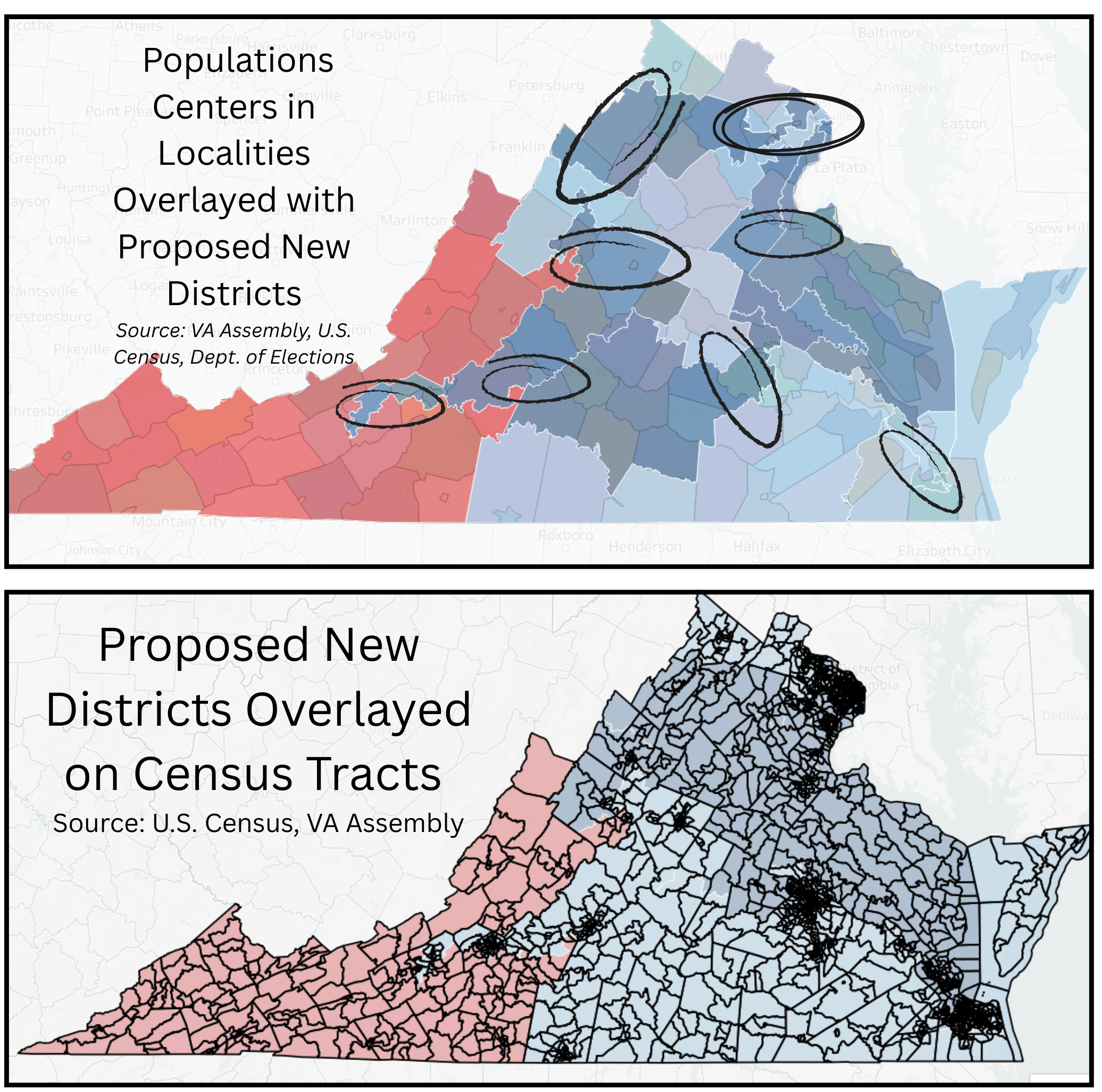
Here are some of the more divided localities with the help of an AI Assistant.

The balloting will be conducted in Virginia’s current voting districts.
More in our next report. To find out about balloting deadlines for the Special Election, see the Department of Elections here. #
Other Developments This Week:
SAVE Act Passes House to Require Proof of Citizenship to Register
The House of Representatives passed the SAVE (Safeguard American Voter Eligibility Act) which requires proof of U.S. Citizenship to register to vote and photo ID to cast a ballot. Sen. Mike Lee (R-Utah) reported he was up to 50 senators, including Democrat John Fetterman, who were supporting the bill.
The question is whether Majority Leader John Thune will allow a “talking” filabuster, which would give the bill a chance to pass without 60 votes. For now, it’s in the Senate’s hands.
DOJ to Receive Nevada’s Voter Rolls
Nebraska’s Republican secretary of state will turn over voter lists requested by the head of the Civil Rights Division at the Department of Justice, Harmeet Dhillon, who is suing 22 states, including Virginia for voter rolls to ensure they are lawful.
The AP reported that the Nebraska Supreme Court denied a request for an injunction to block the DOJ’s request. This will contribute to other cases around the nation that are currently being litigated, or appealed. #