



Americans across the nation are expressing shock and dismay on social media about Virginia Democrats’ blizzard of radical bills that raise a raft of taxes, target Second Amendment rights, decriminalize crime, and allow long-term ID cards for foreign nationals in the United States illegally.
On the crime issue alone, the New York Post reported:
“House Bill 863 would reduce minimum sentencing for rape, manslaughter and child pornography.”
The sentiment across news media and social media networks: demonstrably negative.
Bills that would strip American citizens of Second Amendment rights have attracted comment by the Dept. of Justice.
https://x.com/AAGDhillon/status/2015915779565486212
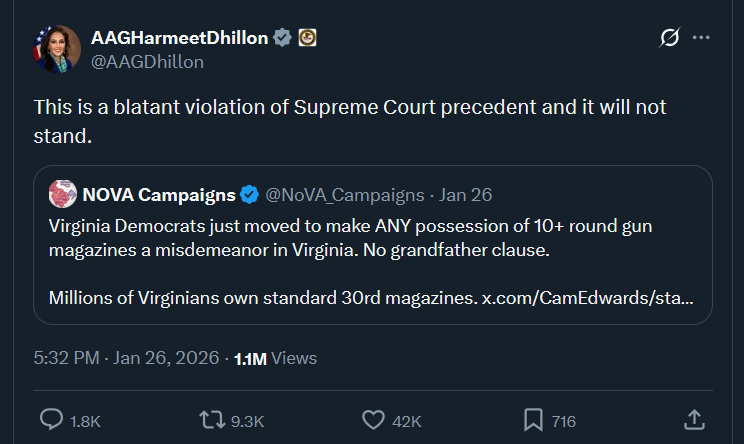
Here’s libertarian publication Reason, which noted just this week: “the Senate Courts of Justice Committee advanced seven bills that shall infringe on one of Americans’ most sacred and important rights.”
Fewer Voices Discussing Election Bills
We have not seen much discussion in the media (beyond accounts on X such as NoVa Campaigns) about the impact on election transparency that some 111 election bills before the majority Democrat assembly represent.
Taken together, they would wrench public oversight of election transparency from citizens — even strip Electoral Boards of their authority, and make voter-roll maintenance cross-checks nearly impossible.
Here are a few:
—One bill would enable pre-9/11 loopholes for “driver privilege cards” with potential for exploitation by foreign nationals in the country illegally.
The bill’s convoluted language has raised concerns that its intent is to further weaken federal immigration laws. It would allow foreign nationals who cannot show legal presence in the U.S. to receive a state-issued driver ID card for eight years. The current duration is two years.
The bill’s backers claim it has just enough language to protect Americans from the kind of fraudulent exploitation that enabled seven of the nine 9/11 hijackers to receive “driver privilege” cards in Virginia in 2001 before they crashed planes into the Twin Towers and the Pentagon.
It is hard to see how a time-extension of state-issued cards, including commercial driver’s licenses for noncitizens, is considered safe merely because it operates outside of the national “REAL ID” system of checking legal presence in the U.S.
As the FBI said in 2001, “unscrupulous lawyers and notaries established a thriving illicit market for processing undocumented aliens for hefty fees” that allowed seven of the 9/11 terrorists to obtain “driver privilege” cards in Virginia.
Somehow, Virginia’s legislative tracking system randomly assigned the bill’s number as HB 911. #
—The Return of ERIC
SB 57 is the Senate version of majority Democrats’ zeal to return Virginia to the controversial private voter-roll organization known as ERIC (Electronic Registration Information Center), whose partisanship and sloppy record-keeping led Virginia to exit in 2023.
See the letter from the Dept. of Elections explaining why Virginia left ERIC. https://www.documentcloud.org/documents/23810805-file_0097-2/
Senate bill 57 sailed through the Democrat majority assembly this past week, and passed on the floor along partisan lines: 21-Y, 17-N.
A companion bill in the House of Delegates, HB 215, aims to untangle Virginia from years of partnerships it built out with some 11 states (memorandum of understanding) on voter-roll maintenance after leaving ERIC.
Election security groups have documented ERIC’s history of duplicating voter-roll maintenance work with the so-called “Eligible but Unregistered” lists it generates, which can create confusion and error.
For example, the Commonwealth of Virginia found “168,000 potential registrants in ERIC’s data who were ineligible to vote because they were deceased or had moved away,” according to election law firm Public Interest Legal Foundation (PILF).
PILF has been litigating over ERIC’s methods for years. It recently won a federal court ruling in Arizona forcing ERIC to show its work on voters it claimed were deceased. Turns out they weren’t really dead.
“Unfortunately ERIC makes mistakes,” said PILF’s founder J. Christian Adams in a statement, “which is why only half the states continue to use its services.”
Perhaps most concerning to Virginians and transparency is ERIC’s membership agreement, which would put member states in violation of federal election statutes.
To wit:
As part of ERIC’s membership agreement, states are not allowed to share certain ERIC data reports with the public. This secrecy violates the National Voter Registration Act (NVRA), which gives the public a right to inspect voter rolls and voter list maintenance documents. PILF won access to these ERIC reports in Alaska and the District of Columbia.
HB 215 was still listed in committee as of January 30th. #
— Electoral Boards as Merely Ministerial
The language in HB 78 is an extension of progressive-left groups’ media crusade to nullify electoral boards around the country by claiming their votes to certify elections are merely ministerial. The bill would reduce boards to rubber stamps on election certification procedures. It could be an invitation to bad behavior in elections.
HB 78 says (emphasis mine):
The certification of the results of an election is a clear ministerial duty of the local electoral boards and that a member of the local electoral board who neglects or refuses to perform such duty in accordance with law shall be subject to removal proceedings by the State Board of Elections and assessed a civil penalty not exceeding $1,000.
The bill also authorizes the State Board of Elections to intervene and carry out the duties related to election certification in the event a local electoral board fails or refuses to do so.
Republican assembly members on the Privileges & Elections sub-committee also voted to advance this bill.
Few, if any, assembly members on both sides of the aisle have spoken out, in committee or elsewhere, about these bills with any authority. During committee hearings this week, some assembly members did not appear to understand the full language in the bills they were sponsoring.
It raises more concerns among observers that lobbyists, activists and entities outside of the assembly — even outside of Virginia — are writing most if not all of the 100-plus election bills, with little input from the public.
These are just some summaries of bills that moved through committee this week. EPEC Team will keep tracking their impact on election systems transparency. #
ICYMI: Court Updates
—Update on Tazewell County Ruling on VA Redistricting
Assembly Democrats have rushed out an appeal of a Tazewell County judge’s ruling last week that found the VA assembly flouted the Constitution, Virginia Statute and its own rules in rushing a referendum vote for redistricting to a special election, per the Washington Post.
Since then, the Court of Appeals of Virginia “has moved to certify the case challenging the Legislature’s redistricting effort to the Virginia Supreme Court” due to its “imperative public importance,” as SCOTUS Wire posted with the court filing.
—D.C. Judge Strikes Again Against Executive Order on Elections
On the eve of more expected appeals by the Department of Justice of a ruling to block parts of President Trump’s Executive Order on Elections, Judge Colleen Kollar-Kotelly issued a third ruling Friday.
This time she appears to be leaning in on the use of adverb to address the executive branch’s oversight of federal election statutes.
She writes: The Court shall also DECLARE that, in the course of implementing Section 2(b) and 3(a) of the Executive Order, which relate to the sharing of data by federal agencies, the Federal Defendants must strictly comply with the mandates of the Privacy Act, including its requirement that agencies provide at least 30 days’ notice and opportunity for comment for any new or intended “routine use” of information stored in an agency’s system of records.”
The ruling appears to insert a view of the law regarding the Attorney General’s broad authority to review voter records. It also wades into “privacy” arguments blue states are using to defy the AG’s authority under the Civil Rights Act to review voter rolls.
Judge Kollar-Kotelly is widely viewed by conservative groups as a notoriously partisan anti-Trump judge. Her third ruling in the case takes aim at the section of the EO that discusses “Enforcing the Citizenship Requirement for Federal Elections.”
Section 2 B of the EO discusses “the type of document that the [registration] applicant presented as documentary proof of United States citizenship, including the date of the document’s issuance, the date of the document’s expiration (if any), the office that issued the document, and any unique identification number associated with the document as required by the criteria in 52 U.S.C. 21083(a)(5)(A), while taking appropriate measures to ensure information security.”
The judge’s ruling also appears to slow down states’ routine use of the “Social Security Number Verification Service, the Death Master File, and any other Federal databases” for ensuring accurate voter rolls.
See the ruling here. #
—HB 966 Says No Bulk Uploads to Cross-Check Voter Lists
Coincidentally, the VA Assembly has also introduced a bill that would slow down list maintenance in the Commonwealth. HB 966 would only allow the Dept. of Elections to search one record at a time using the recently updated SAVE (Systematic Alien Verification for Entitlements) naturalization database.
Make of that what you will.
More on the impact of these bills in our next report. #