



Virginia voters turned out in the low single digits to choose House and Senate candidates for the midterm elections. The numbers who voted on Primary Election day are much lower than past federal elections — in a year of seemingly endless elections.
- Virginia’s Primary Election unofficial results show that, on average, 3.79% of the Commonwealth’s registered electorate voted in Republican primary races to cast 243,572 ballots for U.S. Senate and congressional seats.
- Depending on the locality and which congressional districts, turnout percentages ranged into the low single digits in competitive races.
- For the Democrat candidates, turnout averaged 6.69% of registered voters who cast 211,034 ballots in primaries for congressional races and local offices.
- Other turnout notes: Virginia usually holds primary elections in June. The August time frame for Early Voting and Primary Day in 2026 may have been another factor in the low turnout numbers.
- Summary stats: Democrat party results (unofficial).
- Summary stats: Republican party results (unofficial).
Republicans Choose Mizusawa as U.S. Senate Nominee
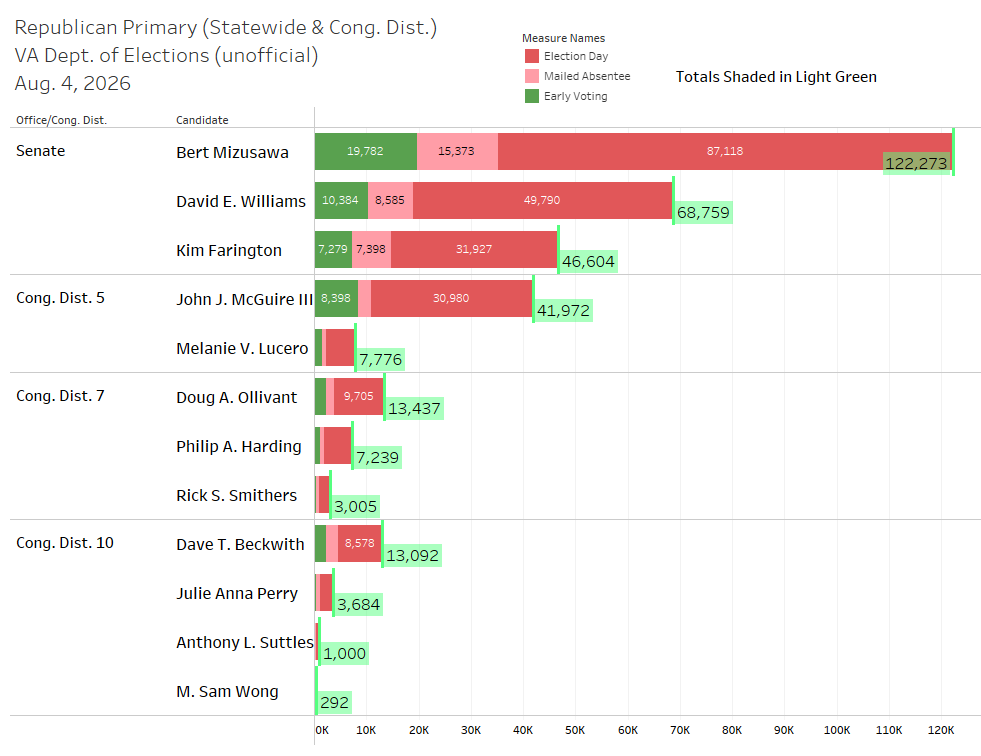
In the statewide Republican primary race for Senate, Bert Mizusawa, a retired Major General of the U.S. Army and Harvard Law School grad, ran away with total votes cast to win the nomination. He will face Democrat incumbent Sen. Mark Warner in the fall.
Mizusawa won every category of voting: Early, Mail-ins and Election day (See ballot breakdowns below).
Congressional candidates in six competitive House Seat races out of Virginia’s 11-seat delegation are set (challengers in italics):
CD 1: Incumbent Republican Rob Whitman vs. Democrat Shannon Taylor
CD 2: Incumbent Republican Jen Kiggans vs. Democrat Elaine Luria
CD 5: Incumbent Republican John McGuire vs. Democrat Tom Perriello
CD 7: Incumbent Democrat “Eugene” Vindman vs. Republican Douglas Ollivant
CD 9: Incumbent Morgan Griffith vs. Democrat Joy Powers
CD 10: Incumbent Democrat Suhas Subramanyam vs. Republican Dave Beckwith
(CD8: Democrat incumbent Rep. Don Beyer fended off four primary challengers to seal his re-election as he faces no Republican in the fall midterm elections.)
Unofficial Summary Results by Ballot Types
- Voters in the Republican party largely showed up on Primary Election Day, though all the winning candidates performed in all three ballot categories.
- See breakout of ballot types below. Totals are shaded in light green. Pinch out to zoom in on mobile devices.
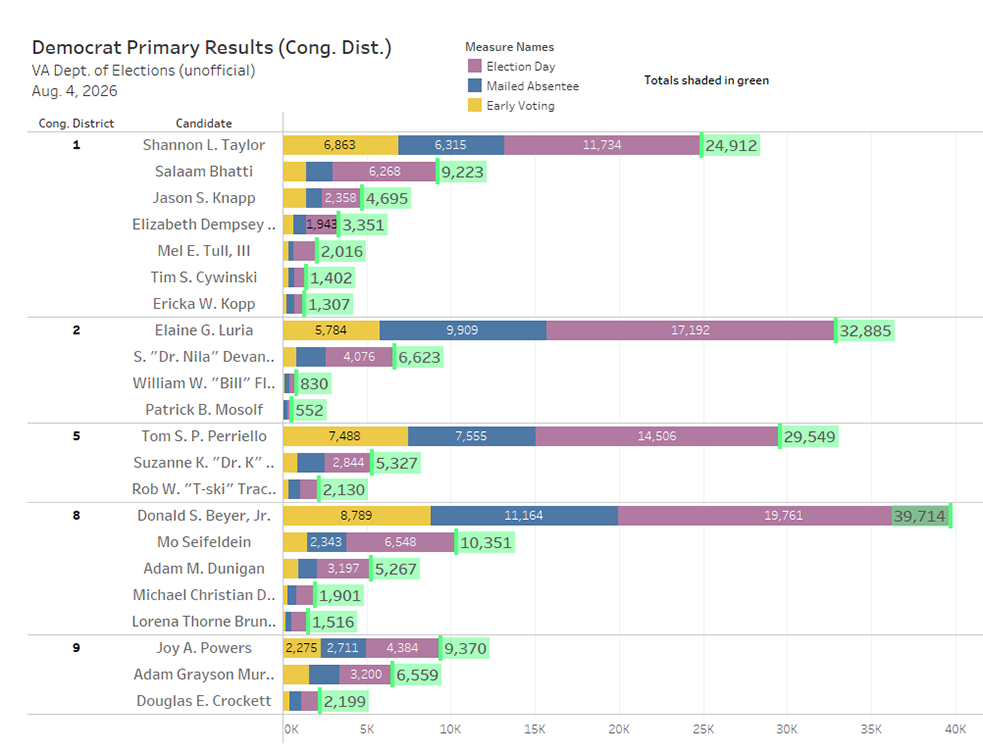
- Democrat congressional primaries show that the majority of voters showed up on Primary Election Day, with fewer mail-ins during the Early Voting stretch — yet enough to make the difference for the winners.
- See breakout of ballot types below. Totals are shaded in light green. Pinch out to zoom in on mobile devices.
Election workers and officers noted a recurring comment they heard from many voters throughout the day: confusion over which congressional districts were holding primaries. Others questioned why voters were not better informed about the primary races and candidates prior to Election Day.
Still others noted that 2026 may be remembered as the year of the exhausted electorate amid one of the busiest years for voting:
—A flurry of special elections to replace candidates who left assembly seats to serve in the Spanberger administration.
—A Special Election on redistricting in April that the Supreme Court of Virginia tossed out as unconstitutional.
Rest up, Virginia voters. The 45-day Early Voting period for the midterm elections begins in about six weeks. #